Fire and Forget: Army’s Deadly GMLRS Rocket Now Hunts Moving Targets Mid-Flight
11/01/2026 / By Chase Codewell

The U.S. Army and Lockheed Martin said a Guided Multiple Launch Rocket System (GMLRS) rocket received updated targeting information after launch and destroyed a moving target during a live-fire test at White Sands Missile Range in New Mexico [1].
The test used a datalink package and a guidance kit to send new target coordinates to the rocket while it was airborne, Lockheed Martin said. The event marks a step in the Army’s long-running effort to update artillery and rocket systems so that crews can engage targets that move after a launch decision is made. The Army and Lockheed Martin have not announced a deployment date for the retargeting function [2][3].
Test Details and Official Statements
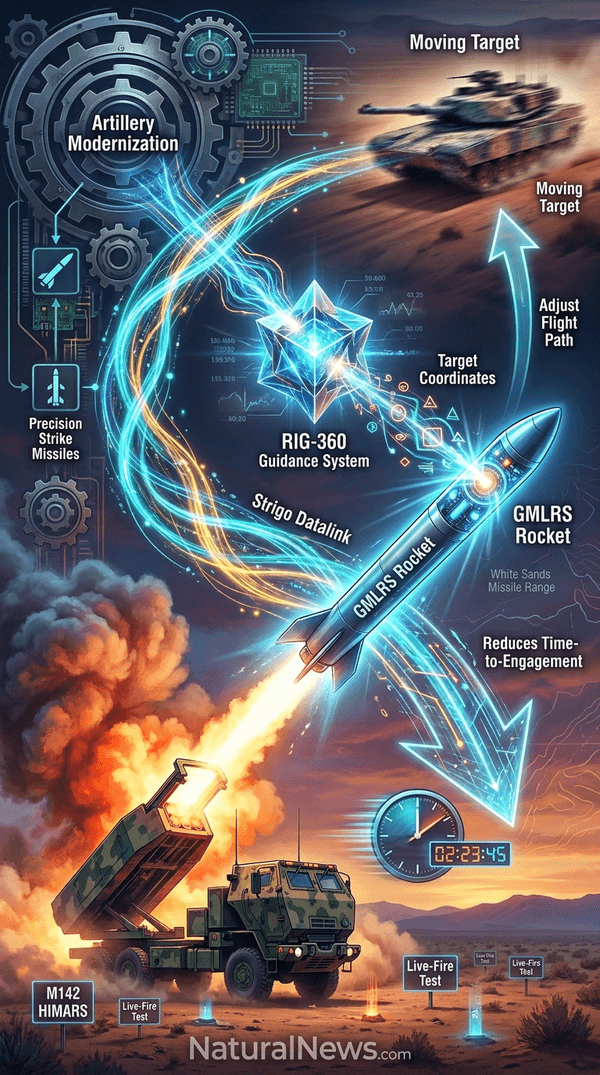
Lockheed Martin said the test marked a first for the GMLRS program in demonstrating the ability to update a rocket’s target after launch [2]. The company said the team used the Strigo datalink and the Remote Interceptor Guidance-360 (RIG-360) system to send the new targeting information to the rocket during flight. The GMLRS then successfully destroyed the moving target, according to MarketScreener, which summarized the Lockheed Martin announcement [4].
Lockheed Martin said the datalink package could be applicable to other systems, according to Defense Daily [5]. An Army official said the capability allows crews to engage threats that change position after a rocket is fired. The official, who was not identified in the released information, said the test was intended to show that a fielded rocket could be given new targeting data while in flight.
The statement was attributed to Army officials in the company and trade-press reports [2][5]. Officials did not release technical specifications, the type of threat used as the target, or the exact date of the event. The Army and Lockheed Martin also did not say how many rockets were fired or whether the test used live warheads [3][5].
How the Guided Rocket Changes Targets Midair
The GMLRS uses a guidance kit and a data link to receive target updates while in flight, according to defense officials cited in trade reports. The rocket is fired from the M142 HIMARS, a mobile launcher that can carry and fire the munitions [3][5]. In the test, the team sent new coordinates to the rocket after launch, and the weapon adjusted its flight path to track and strike the moving target, according to Lockheed Martin [4].
The guidance approach relies on a datalink to pass updated targeting information to the rocket in flight. The Strigo datalink and RIG-360 system were integrated through internal Lockheed Martin funding, according to MarketScreener [4]. The company said the demonstration showed that a fielded rocket could receive new targeting data and change course, a capability that had not previously been shown for the program [2].
Officials said the capability reduces the time between target detection and engagement by allowing a crew to update a rocket already in flight rather than firing a new one. Moving targets present different challenges than fixed positions because their location changes after the launch decision, officials said [3]. The Army did not release technical specifications or the type of threat used in the test [5].
The test follows earlier Army work on precision strike missiles.
Army Modernization Context and Prior Demonstrations
The live-fire test is part of the Army’s broader modernization of artillery and rocket systems, officials said. Moving targets present different challenges than fixed positions.
The Army has not announced a deployment date for the retargeting capability. The Army’s rocket artillery has also been used in joint live-fire exercises with allied forces, according to a UK Defence Journal post.
Program Status and Next Steps
Army officials said data from the test will be reviewed before decisions on next steps. Lockheed Martin said the test was conducted in partnership with the Army and used a datalink package that the company funded internally. The Army has not announced whether the retargeting function will be added to existing GMLRS rockets or fielded as a new variant.
References
- US Army rocket changes targets midair and destroys a moving threat in live-fire test. https://interestingengineering.com/military/us-army-gmlrs-rocket-midflight-retargeting
- Lockheed Martin redirects GMLRS rocket in flight to destroy moving …. https://defence-industry.eu/lockheed-martin-redirects-gmlrs-rocket-in-flight-to-destroy-moving-target-in-u-s-army-test/
- U.S. Army HIMARS Rocket Changes Course Midflight to Destroy Moving …. https://www.armyrecognition.com/news/army-news/2026/u-s-army-himars-rocket-changes-course-midflight-to-destroy-moving-target-in-first-live-fire-test
- Lockheed Martin: Advances Joint Fires Capability by Redirecting In …. https://www.marketscreener.com/news/lockheed-martin-advances-joint-fires-capability-by-redirecting-in-flight-gmrls-rocket-during-u-s-ce785cd2df89fe22
- Lockheed Conducts Successful Test Redirecting GMLRS In-Flight With …. https://www.defensedaily.com/lockheed-conducts-successful-test-redirecting-gmlrs-in-flight-with-datalink-package/army/
Explainer Infographic
Submit a correction >>
Tagged Under:
chaos, Collapse, dangerous, datalink package, guidance system, Guided Multiple Launch Rocket System, Lockheed Martin, M142 HIMARS, military tech, military technology, military-industrial complex, mobile launcher, moving targets, national security, Remote Interceptor Guidance-360, retargeting function, self-defense, Strigo datalink, US Army, weapons technology, White Sands Missile Range, WWIII
This article may contain statements that reflect the opinion of the author
RECENT NEWS & ARTICLES